Viewing archive of Monday, 16 September 2002
Solar activity report
Any mentioned solar flare in this report has a scaling factor applied by the Space Weather Prediction Center (SWPC). Because of the SWPC scaling factor, solar flares are reported as 42% smaller than for the science quality data. The scaling factor has been removed from our archived solar flare data to reflect the true physical units.
Report of Solar-Geophysical Activity 2002 Sep 16 2200 UTCPrepared by the NOAA © SWPC and processed by SpaceWeatherLive.com
Joint USAF/NOAA Report of Solar and Geophysical Activity
SDF Number 259 Issued at 2200Z on 16 Sep 2002IA. Analysis of Solar Active Regions and Activity from 15-2100Z to 16-2100Z Solar activity was at moderate levels. Region 114
(S12W28) produced an M1/Sn flare at 16/0310 UTC with an associated
Type II radio sweep that had an estimated shock velocity of 750
km/s. This region was also the source for several lesser C-class
flares during the period. Spot group continues to show decay
although beta-gamma magnetic structure remains intact. Region 105
(S07W44) was limited to minor C-class flare production today and
underwent little change during the period. Newly numbered Region
119 (S14E32) became active during the day, producing minor C-class
flare activity. A 34 degree solar filament erupted in the northeast
quadrant late in the period yesterday seen on SOHO/EIT imagery. New
Regions 118 (N14E14), 120 (S19E57), 121 (S14E69), and 122 (S19E74)
were assigned today.
IB. Solar Activity Forecast
Solar activity is expected to be low
to moderate.
IIA. Geophysical Activity Summary 15-2100Z to 16-2100Z
The geomagnetic field was at predominantly quiet levels. Isolated
unsettled conditions were observed at high latitudes. The greater
than 2 MeV electron flux has been high today.
IIB. Geophysical Activity Forecast
The geomagnetic field is
expected to be quiet to unsettled. There is a chance for isolated
active conditions on day three of the forecast period due to a
possible weak shock passage from the M1/Sn flare mentioned in IA.
Greater than 2 MeV electron flux is expected to remain moderate to
high for days one and two of the forecast period.
III. Event Probabilities 17 Sep to 19 Sep
| Class M | 50% | 50% | 50% |
| Class X | 05% | 05% | 05% |
| Proton | 05% | 05% | 05% |
| PCAF | green | ||
IV. Penticton 10.7 cm Flux
  Observed       16 Sep 183
  Predicted   17 Sep-19 Sep  180/180/175
  90 Day Mean        16 Sep 177
V. Geomagnetic A Indices
  Observed Afr/Ap 15 Sep  005/008
  Estimated     Afr/Ap 16 Sep  006/008
  Predicted    Afr/Ap 17 Sep-19 Sep  006/008-006/008-006/008
VI. Geomagnetic Activity Probabilities 17 Sep to 19 Sep
| A. Middle Latitudes | |||
|---|---|---|---|
| Active | 15% | 15% | 15% |
| Minor storm | 01% | 01% | 01% |
| Major-severe storm | 01% | 01% | 01% |
| B. High Latitudes | |||
|---|---|---|---|
| Active | 20% | 20% | 20% |
| Minor storm | 05% | 05% | 05% |
| Major-severe storm | 01% | 01% | 01% |
All times in UTC
Latest news

Monday, 30 March 2026
X1.5 solar flare

Tuesday, 17 March 2026
M2.7 solar flare, CME arrival possible
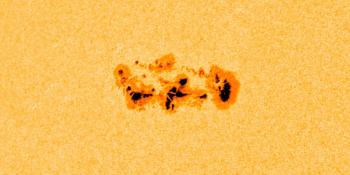
Sunday, 1 February 2026
Complex sunspot region 4366
Latest forum messages
AR4409 185GoPro tips -which model, what settings etc 9Unspecified geomagnetic activity 139Current Farside Activity 442Artemis 2 Live 7
More topicsSupport SpaceWeatherLive.com!
A lot of people come to SpaceWeatherLive to follow the Solar activity or if there is a chance to see the aurora, but with more traffic comes higher costs to keep the servers online. If you like SpaceWeatherLive and want to support the project you can choose a subscription for an ad-free site or consider a donation. With your help we can keep SpaceWeatherLive online!



Space weather facts
| Last X-flare | 2026/03/30 | X1.5 |
| Last M-flare | 2026/04/09 | M1.0 |
| Last geomagnetic storm | 2026/04/03 | Kp7- (G3) |
| Spotless days | |
|---|---|
| Last 365 days | 3 days |
| 2026 | 3 days (3%) |
| Last spotless day | 2026/02/24 |
| Monthly mean Sunspot Number | |
|---|---|
| March 2026 | 85.9 +7.7 |
| April 2026 | 118.8 +32.8 |
| Last 30 days | 102.1 +47 |
This day in history*
Aurora on this day in history
No observations submitted for this day in history. If you've observed the aurora and you have some amazing photos to show off, submit your observations now!
Submit your aurora observation