Viewing archive of Wednesday, 18 June 2003
Geophysical report
Any mentioned solar flare in this report has a scaling factor applied by the Space Weather Prediction Center (SWPC). Because of the SWPC scaling factor, solar flares are reported as 42% smaller than for the science quality data. The scaling factor has been removed from our archived solar flare data to reflect the true physical units.
Solar and Geophysical Activity Summary 2003 Jun 18 0245 UTCPrepared by the NOAA © SWPC and processed by SpaceWeatherLive.com
Joint USAF/NOAA Solar and Geophysical Activity Summary
SGAS Number 169 Issued at 0245Z on 18 Jun 2003 This report is compiled from data received at SWO on 17 JunA. Energetic Events
Begin  Max  End  Rgn   Loc   Xray  Op 245MHz 10cm   Sweep
2144 2153 2158  0386 S07E55 C5.2  1f        140
2227 2255 2312  0386        M6.8     1200   2100   II/IV
B. Proton Events
None
C. Geomagnetic Activity Summary
The geomagnetic field was at
active to major storm levels. A six-hour period of southward Bz,
from 06 - 09 UTC combined with elevated solar wind speed near 510
km/s produced minor and major storm levels. Greater than 2 MeV
fluence levels were at background levels today.
D. Stratwarm
None
E. Daily Indices: (real-time preliminary/estimated values)
10 cm 122  SSN 080  Afr/Ap 040/050   X-ray Background B2.8
Daily Proton Fluence (flux accumulation over 24 hrs)
GT 1 MeV 7.9e+05   GT 10 MeV 1.8e+04 p/(cm2-ster-day)
(GOES-8 satellite synchronous orbit W127 degrees)
Daily Electron Fluence
GT 2 MeV 8.00e+06 e/(cm2-ster-day)
(GOES-12 satellite synchronous orbit W76 degrees)
3 Hour K-indices
Boulder 5 5 6 5 4 4 3 4 Planetary 5 6 6 6 4 4 4 4
F. Comments
  K-Indices:
On 16 June, it was determined that a scaling problem exists with the
H-trace on the Boulder magnetometer instrument.  While this problem,
and its fix are being investigated the primary instrument for
Boulder K-indices has been switched to the Boulder USGS (via Domsat)
magnetometer, effective 1500 UTC on 16 June.

GOES Protons:
To ensure continued operational monitoring of important energetic
particle data, it is necessary to reassign primary/secondary
designations for the GOES Space Environment Monitor (SEM) detectors.
Beginning 1700 UTC on June 18, GOES 11 (105W) will become the
primary satellite for protons. GOES 12 will continue as the primary
satellite for magnetometer, X-ray, and electron measurements. GOES
10 (135W) will be the secondary satellite for all SEM sensors -
magnetometer, X-ray, and energetic particles.  Because of the
degraded state of the proton data on GOES-10, its designation as the
secondary source for proton data is a short-term solution.  More
permanent solutions have been identified and are being evaluated.
Users will be notified when we define and schedule a permanent fix.
Further details can be found at http://www.sec.noaa.gov/GOES.html.
All times in UTC
Latest news

Monday, 30 March 2026
X1.5 solar flare

Tuesday, 17 March 2026
M2.7 solar flare, CME arrival possible
Sunday, 1 February 2026
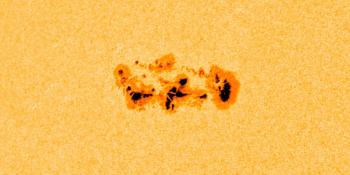
Complex sunspot region 4366
Latest forum messages
More topicsSupport SpaceWeatherLive.com!
A lot of people come to SpaceWeatherLive to follow the Solar activity or if there is a chance to see the aurora, but with more traffic comes higher costs to keep the servers online. If you like SpaceWeatherLive and want to support the project you can choose a subscription for an ad-free site or consider a donation. With your help we can keep SpaceWeatherLive online!



Space weather facts
| Last X-flare | 2026/03/30 | X1.5 |
| Last M-flare | 2026/04/04 | M1.0 |
| Last geomagnetic storm | 2026/04/03 | Kp7- (G3) |
| Spotless days | |
|---|---|
| Last 365 days | 3 days |
| 2026 | 3 days (3%) |
| Last spotless day | 2026/02/24 |
| Monthly mean Sunspot Number | |
|---|---|
| March 2026 | 85.9 +7.7 |
| April 2026 | 118.8 +32.8 |
| Last 30 days | 102.1 +47 |
This day in history*
Aurora on this day in history
No observations submitted for this day in history. If you've observed the aurora and you have some amazing photos to show off, submit your observations now!
Submit your aurora observation