Viewing archive of Friday, 18 July 2003
Solar activity report
Any mentioned solar flare in this report has a scaling factor applied by the Space Weather Prediction Center (SWPC). Because of the SWPC scaling factor, solar flares are reported as 42% smaller than for the science quality data. The scaling factor has been removed from our archived solar flare data to reflect the true physical units.
Report of Solar-Geophysical Activity 2003 Jul 18 2200 UTCPrepared by the NOAA © SWPC and processed by SpaceWeatherLive.com
Joint USAF/NOAA Report of Solar and Geophysical Activity
SDF Number 199 Issued at 2200Z on 18 Jul 2003IA. Analysis of Solar Active Regions and Activity from 17-2100Z to 18-2100Z Solar activity was at low levels. Region 410 (S11W01)
produced two consecutive C5 flares at 17/2356Z and 18/0005Z. Region
410 continues to increase in area coverage and magnetic complexity.
Region 412 (N17W06) exhibited growth in area and magnetic
complexity, developing a beta-gamma magnetic configuration due to
mixing polarities in the trailing spots. Region 409 (N15E05)
continued its gradual decay and simplified to a beta magnetic
configuration. New Region 414 (S02E58) was numbered today.
IB. Solar Activity Forecast
Solar activity is expected to be low
to moderate. Regions 410, and 412 have the potential for M-class
activity over the next three days. Region 409 has the potential for
M-class activity on day one.
IIA. Geophysical Activity Summary 17-2100Z to 18-2100Z
The geomagnetic field has been quiet to active. Active conditions
were observed early in the period. Solar wind speed decreased from
600 km/s to 500 km/s around 18/0700Z and remained at 500 km/s for
the remainder of the day. This decrease marks the end of the
coronal hole high speed stream.
IIB. Geophysical Activity Forecast
The geomagnetic field is
expected to be at quiet to unsettled levels. Isolated active
conditions are possible during night time hours.
III. Event Probabilities 19 Jul to 21 Jul
| Class M | 45% | 45% | 45% |
| Class X | 05% | 05% | 05% |
| Proton | 05% | 05% | 05% |
| PCAF | green | ||
IV. Penticton 10.7 cm Flux
  Observed       18 Jul 140
  Predicted   19 Jul-21 Jul  135/140/140
  90 Day Mean        18 Jul 127
V. Geomagnetic A Indices
  Observed Afr/Ap 17 Jul  014/022
  Estimated     Afr/Ap 18 Jul  012/012
  Predicted    Afr/Ap 19 Jul-21 Jul  015/015-015/015-012/012
VI. Geomagnetic Activity Probabilities 19 Jul to 21 Jul
| A. Middle Latitudes | |||
|---|---|---|---|
| Active | 35% | 35% | 25% |
| Minor storm | 20% | 20% | 15% |
| Major-severe storm | 05% | 05% | 01% |
| B. High Latitudes | |||
|---|---|---|---|
| Active | 35% | 35% | 35% |
| Minor storm | 20% | 20% | 20% |
| Major-severe storm | 05% | 05% | 05% |
All times in UTC
Latest news

Monday, 30 March 2026
X1.5 solar flare

Tuesday, 17 March 2026
M2.7 solar flare, CME arrival possible
Sunday, 1 February 2026
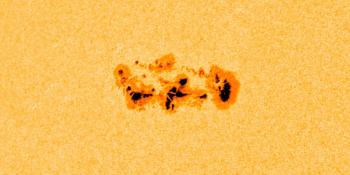
Complex sunspot region 4366
Latest forum messages
Comet C/2026 A1 (MAPS) for the southern hemisphere 51AR4405 243AR4409 159Current Farside Activity 438Incoming & Unnumbered Active Regions 257
More topicsSupport SpaceWeatherLive.com!
A lot of people come to SpaceWeatherLive to follow the Solar activity or if there is a chance to see the aurora, but with more traffic comes higher costs to keep the servers online. If you like SpaceWeatherLive and want to support the project you can choose a subscription for an ad-free site or consider a donation. With your help we can keep SpaceWeatherLive online!



Space weather facts
| Last X-flare | 2026/03/30 | X1.5 |
| Last M-flare | 2026/04/04 | M1.3 |
| Last geomagnetic storm | 2026/04/03 | Kp7- (G3) |
| Spotless days | |
|---|---|
| Last 365 days | 3 days |
| 2026 | 3 days (3%) |
| Last spotless day | 2026/02/24 |
| Monthly mean Sunspot Number | |
|---|---|
| March 2026 | 85.9 +7.7 |
| April 2026 | 133.3 +47.4 |
| Last 30 days | 96.9 +35.1 |
This day in history*
Aurora on this day in history
No observations submitted for this day in history. If you've observed the aurora and you have some amazing photos to show off, submit your observations now!
Submit your aurora observation