Viewing archive of Sunday, 27 October 2013
Daily bulletin on solar and geomagnetic activity from the SIDC
Issued: 2013 Oct 27 1205 UTC
SIDC Forecast
Solar flares
Active (M-class flares expected, probability >=50%)
Geomagnetism
Minor storm expected (A>=30 or K=5)
Solar protons
Quiet
| 10cm flux | Ap | |
|---|---|---|
| 27 Oct 2013 | 158 | 006 |
| 28 Oct 2013 | 160 | 023 |
| 29 Oct 2013 | 159 | 023 |
Bulletin
There were two M flares and eleven C flares on the Sun in the past 24 hours. New region NOAA AR 11884 in the East produced an M3.1 flare peaking at 19:27 UT on October 26 while beta-gamma-delta region AR 11882 released an M1.0 flare peaking at 19:53 UT on October 26. The other flares were produced by AR 11882, 11875, 11877 and 11873. In the next 48 hours, M flares are expected, with a chance for X flares. LASCO C2 and STEREO COR2 A and B observed several CMEs on October 26 and 27, among which a partial halo CME first registered by LASCO C2 at 11:24 UT on October 26 (associated with the M1.8 flare of 11:17 UT). This CME could deliver a glancing blow in the second half of October 29. ACE observed a jump in the solar wind at 21:44 UT on October 26. Solar wind speed jumped from about 280 to 310 km/s, while the Interplanetary Magnetic Field jumped from 4.5 to 6.5 nT. A smooth decrease in the phi angle clearly shows rotation of the Interplanetary Magnetic Field consistent with the flux rope of an ICME. This jump was probably the result of the arrival of the October 22 (M4.2) CME. Phi jumped from 110 to 270 degrees around 9h UT on October 27, probably indicating the end of the (weak) ICME influence and return to nominal conditions, with solar wind speed around 270 km/s and Interplanetary Magnetic Field around 2 nT. Geomagnetic activity was at quiet levels (K Dourbes between 0 and 2; NOAA Kp between 0 and 1) during the past 24 hours. Quiet geomagnetic conditions (K Dourbes < 4) are expected for the second half of October 27 and the first half of October 28. Active conditions with minor storm intervals are possible on the second half of October 28 and the first half of October 29, due to the expected joint arrival of several CMEs, mainly from October 25. Active geomagnetic levels are possible in the second half of October 29, due to a possible glancing blow by the partial halo CME of October 26.
Today's estimated international sunspot number (ISN): 099, based on 13 stations.Solar indices for 26 Oct 2013
| Wolf number Catania | /// |
| 10cm solar flux | 165 |
| AK Chambon La Forêt | 005 |
| AK Wingst | 002 |
| Estimated Ap | 001 |
| Estimated international sunspot number | 090 - Based on 20 stations |
Noticeable events summary
| Day | Begin | Max | End | Loc | Strength | OP | 10cm | Catania/NOAA | Radio burst types |
|---|---|---|---|---|---|---|---|---|---|
| 26 | 1048 | 1117 | 1134 | S05E58 | M1.8 | 1N | 380 | 23/1882 | |
| 26 | 1924 | 1927 | 1930 | S09E81 | M3.1 | SF | --/1884 | ||
| 26 | 1949 | 1953 | 1958 | S07E53 | M1.0 | SF | 23/1882 |
Provided by the Solar Influences Data analysis Center© - SIDC - Processed by SpaceWeatherLive
All times in UTC
Latest news
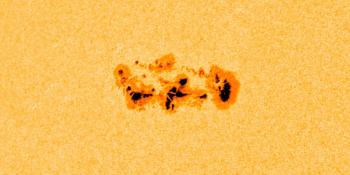
Complex sunspot region 4366

CME impact! S4 solar radiation storm

X1.9 solar flare with earth-directed CME
Latest forum messages
Support SpaceWeatherLive.com!
A lot of people come to SpaceWeatherLive to follow the Solar activity or if there is a chance to see the aurora, but with more traffic comes higher costs to keep the servers online. If you like SpaceWeatherLive and want to support the project you can choose a subscription for an ad-free site or consider a donation. With your help we can keep SpaceWeatherLive online!



Space weather facts
| Last X-flare | 2026/02/04 | X4.3 |
| Last M-flare | 2026/02/11 | M1.3 |
| Last geomagnetic storm | 2026/02/05 | Kp5+ (G1) |
| Spotless days | |
|---|---|
| Last spotless day | 2022/06/08 |
| Monthly mean Sunspot Number | |
|---|---|
| January 2026 | 112.6 -11.4 |
| February 2026 | 129.4 +16.8 |
| Last 30 days | 129.3 +29.3 |