Viewing archive of Thursday, 27 November 2025
Daily bulletin on solar and geomagnetic activity from the SIDC
Issued: 2025 Nov 27 1231 UTC
SIDC Forecast
Solar flares
C-class flares expected, (probability >=50%)
Geomagnetism
Active conditions expected (A>=20 or K=4)
Solar protons
Quiet
| 10cm flux | Ap | |
|---|---|---|
| 27 Nov 2025 | 120 | 014 |
| 28 Nov 2025 | 118 | 016 |
| 29 Nov 2025 | 116 | 012 |
Solar Active Regions and flaring
Solar flaring activity was low over the past 24 hours, with five C-class flares identified. SIDC Sunspot Group (SG) 706 (NOAA Active Region [AR] 4291, Beta-Gamma magnetic configuration) and SIDC SG 707 (NOAA AR 4292, Beta-Gamma magnetic configuration) produced all the flaring activity. The brightest flare of the past 24 hours was SIDC flare 6207, a C2, that peaked on 27 Nov at 00:47 UTC and is associated with SIDC SG 706. More C-class flaring activity is expected in the next 24 hours, mostly from SIDC SG 706.
Coronal mass ejections
No Earth-directed Coronal Mass Ejections (CME) were observed in the last 24 hours.
Solar wind
Over the past 24 hours, solar wind parameters (ACE and DSCOVR) reflected the waning influence of a high-speed stream (HSS). The solar wind speed gradually decreased from about 700 km/s to 630 km/s. The interplanetary magnetic field (B) varied between 2 and 8 nT and its North- South component (Bz) fluctuated between -6 and 6 nT. The SW speed is expected to continue its slow decline and the magnetic field is expected continue at similar levels in the next 24 hours.
Geomagnetism
Geomagnetic conditions registered globally minor storm levels for a short period of time (NOAA Kp 5- on 27 Nov from 09:00 to 12:00 UTC) while the rest of the past 24 hours varied between unsettled and active conditions (NOAA Kp 3 to 4). Locally minor storm conditions (K BEL 5) also registered but for a different time interval (26 Nov 15:00-18:00 UTC). Quiet to active conditions prevailed locally for the remaining of the past 24 hours. Active and possibly minor storm conditions are expected for the next 24 hours.
Proton flux levels
The greater than 10 MeV proton flux, as measured by the GOES-19 satellite, was at background levels over the past 24 hours and is likely to remain so in the next 24 hours.
Electron fluxes at geostationary orbit
The greater than 2 MeV electron flux, as measured by GOES-19, was above the 1000 pfu threshold during the past 24 hours with a peak value of 10000 pfu on 16 Nov at 15:30 UTC. The electron flux is expected to continue exceeding this threshold over the next day. The 24-hour electron fluence was at moderate levels during the past 24 hours and is expected to remain at moderate levels over the next day.
Today's estimated international sunspot number (ISN): 091, based on 07 stations.Solar indices for 26 Nov 2025
| Wolf number Catania | /// |
| 10cm solar flux | 120 |
| AK Chambon La Forêt | 028 |
| AK Wingst | 025 |
| Estimated Ap | 025 |
| Estimated international sunspot number | 083 - Based on 16 stations |
Noticeable events summary
| Day | Begin | Max | End | Loc | Strength | OP | 10cm | Catania/NOAA | Radio burst types | |
|---|---|---|---|---|---|---|---|---|---|---|
| None | ||||||||||
Provided by the Solar Influences Data analysis Center© - SIDC - Processed by SpaceWeatherLive
All times in UTC
Latest news
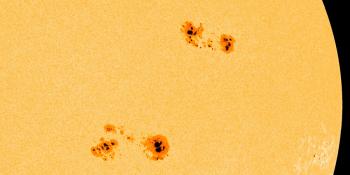
X1.1 solar flare, G2 watch
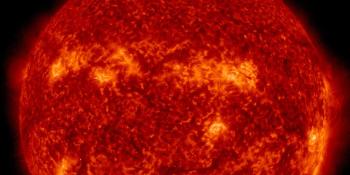
G3 geomagnetic storm watch for 4 and 5 June
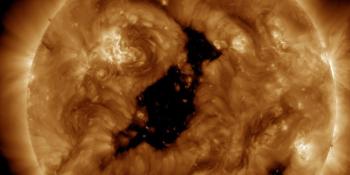
Coronal hole faces Earth
Latest forum messages
Support SpaceWeatherLive.com!
A lot of people come to SpaceWeatherLive to follow the Solar activity or if there is a chance to see the aurora, but with more traffic comes higher costs to keep the servers online. If you like SpaceWeatherLive and want to support the project you can choose a subscription for an ad-free site or consider a donation. With your help we can keep SpaceWeatherLive online!



Space weather facts
| Last X-flare | 2026/07/04 | X1.3 |
| Last M-flare | 2026/07/12 | M1.19 |
| Last geomagnetic storm | 2026/07/04 | Kp7+ (G3) |
| Spotless days | |
|---|---|
| Last 365 days | 3 days |
| 2026 | 3 days (2%) |
| Last spotless day | 2026/02/24 |
| Monthly mean Sunspot Number | |
|---|---|
| June 2026 | 94.4 -7.1 |
| July 2026 | 74.8 -19.6 |
| Last 30 days | 87 -20.2 |