Filament eruption, G1 storm watch
Monday, 22 February 2021 19:10 UTC

We are hopping in the way back time machine today and take you back to... Saturday. Yes... Saturday... Saturday as in two days ago. A filament eruption occurred around 11 UTC on the Sun's southern hemisphere and launched a partial halo coronal mass ejection which could impact our planet.
Solar filaments are clouds of ionized gas above the solar surface squeezed between magnetic regions of opposite polarity. Being cooler and denser than the plasma underneath and their surroundings, they appear as dark lines when seen on the solar disk.
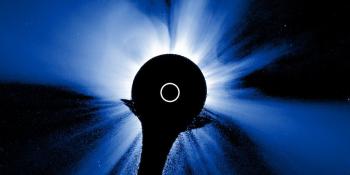
Solar filaments can remain stable for a long time but sometimes they collapse back onto the Sun or break free and eject into space. That is exactly what happened two days ago. A filament on the Sun's southern hemisphere erupted away from the Sun (see the header image as captured by NASA SDO) and was launched into space. We can see the resulting coronal mass ejection (CME) on the images taken by SOHO (play the video below).
A filament eruption on 20 February launched a partial halo CME in space as seen by SOHO. A glancing blow is much possible on 23-24 February. Geomagnetic storm conditions up to the G1 (Kp5) level are possible under the right conditions. pic.twitter.com/kLfgnN9u6I
— SpaceWeatherLive (@_SpaceWeather_) February 22, 2021
A partial halo coronal mass ejection can be seen as it expands into interplanetary space. While most of the ejecta is heading well east of our planet, we can not rule out a glancing blow on 23-24 February. The NOAA SWPC has issued a minor G1 geomagnetic storm watch for these dates.
Thank you for reading this article! Did you have any trouble with the technical terms used in this article? Our help section is the place to be where you can find in-depth articles, a FAQ and a list with common abbreviations. Still puzzled? Just post on our forum where we will help you the best we can!
Latest news
M8.1 solar flare with earth-directed CME
X1.9 solar flare, Coronal hole faces Earth
X4.0 solar flare
Latest forum messages
Support SpaceWeatherLive.com!
A lot of people come to SpaceWeatherLive to follow the Solar activity or if there is a chance to see the aurora, but with more traffic comes higher costs to keep the servers online. If you like SpaceWeatherLive and want to support the project you can choose a subscription for an ad-free site or consider a donation. With your help we can keep SpaceWeatherLive online!



Space weather facts
| Last X-flare | 2025/12/08 | X1.1 |
| Last M-flare | 2025/12/12 | M1.1 |
| Last geomagnetic storm | 2025/12/12 | Kp5 (G1) |
| Spotless days | |
|---|---|
| Last spotless day | 2022/06/08 |
| Monthly mean Sunspot Number | |
|---|---|
| November 2025 | 91.8 -22.8 |
| December 2025 | 144.3 +52.5 |
| Last 30 days | 107.9 +9.5 |