X1.6 CME, evolution of sunspot region 2205
Saturday, 8 November 2014 18:05 UTC
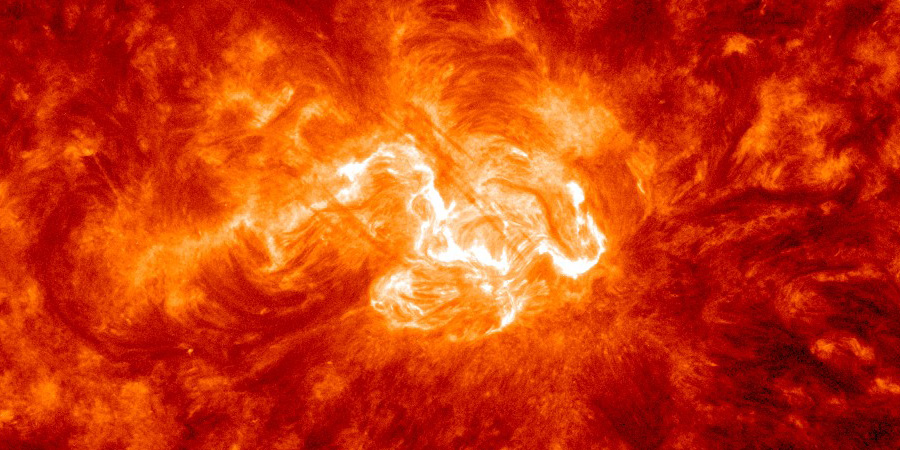
Solar activity has been at low levels (only C-class solar flares) since the X1.6 solar flare from sunspot region 2205 that occurred yesterday. We already mentioned in our previous article that the X1.6 coronal mass ejection is traveling mostly in an eastward direction and away from Earth. However, the coronal mass ejection was fairly wide covering well over 180 degrees on LASCO imagery which could indicate that we can not exclude a shock passage late on November 10. If we do see a shock passage it would be only a minor event at most and a geomagnetic storm is not to be expected. The NOAA SWPC nonetheless put out a warning for possible moderate G2 geomagnetic storming conditions on 10 November.
Evolution of sunspot region 2205
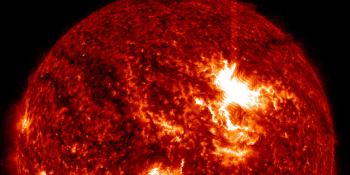
Sunspot region 2205 didn't change much since our last analysis a day ago. It's relatively stable with some minor decay in the central part and some new spots as well. It still has the same magnetic complexity as yesterday (Beta-Gamma-Delta) with at least three magnetic delta structures that gained size over the past 24 hours. The two central delta formations are very close to the spots of opposite polarity making it very compact and we can right away conclude that this sunspot region is capable of more strong solar flares. Although we didn't see much activity since the X1.6 solar flare from yesterday, an M-class event is very likely with a fair chance for an X-class solar flare in the next 24 hours. Should a future eruption produce a coronal mass ejection, then there will be a reasonable chance that at least a part of it will come towards Earth as this sunspot region is now rotating into a geo-effective position.
M-class flare probability for the coming 24 hours: 70% chance
X-class flare probability for the coming 24 hours: 30% chance
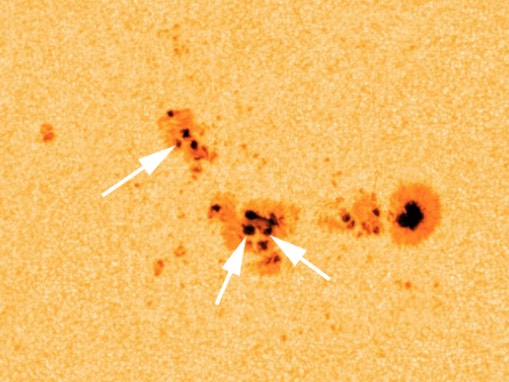
All the other sunspot regions on the disk are unremarkable and unlikely to produce strong solar flares. Any future solar flares will very likely be centered around sunspot region 2205.
Images: NASA SDO and ESA/NASA SOHO.
Thank you for reading this article! Did you have any trouble with the technical terms used in this article? Our help section is the place to be where you can find in-depth articles, a FAQ and a list with common abbreviations. Still puzzled? Just post on our forum where we will help you the best we can!
Latest news
X1.9 solar flare, Coronal hole faces Earth
X4.0 solar flare
X5.1 solar flare, G4 geomagnetic storm watch
Latest forum messages
Support SpaceWeatherLive.com!
A lot of people come to SpaceWeatherLive to follow the Solar activity or if there is a chance to see the aurora, but with more traffic comes higher costs to keep the servers online. If you like SpaceWeatherLive and want to support the project you can choose a subscription for an ad-free site or consider a donation. With your help we can keep SpaceWeatherLive online!



Space weather facts
| Last X-flare | 2025/12/01 | X1.9 |
| Last M-flare | 2025/12/04 | M6.0 |
| Last geomagnetic storm | 2025/12/04 | Kp5 (G1) |
| Spotless days | |
|---|---|
| Last spotless day | 2022/06/08 |
| Monthly mean Sunspot Number | |
|---|---|
| November 2025 | 91.8 -22.8 |
| December 2025 | 186 +94.2 |
| Last 30 days | 106.3 +12.6 |