DSCOVR successfully launched, SDO 5 years in space
Thursday, 12 February 2015 00:18 UTC
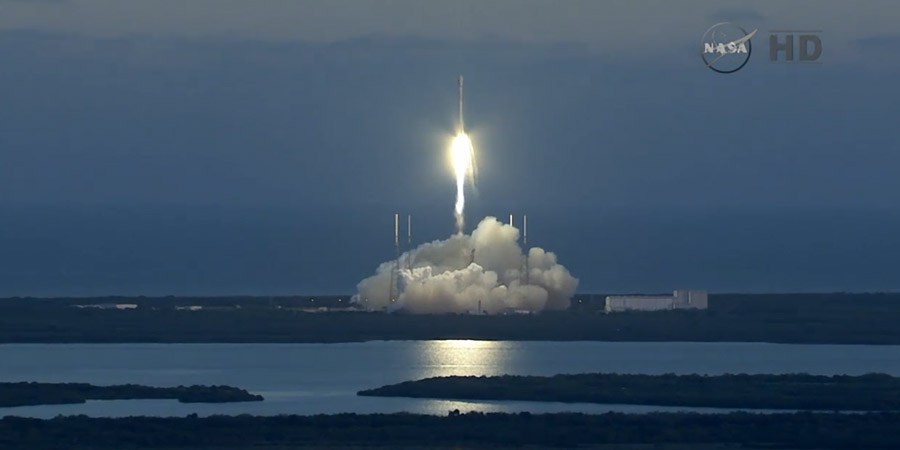
The Deep Space Climate Observatory (DSCOVR) satellite was successfully launched by a SpaceX Falcon 9 rocket from Cape Canaveral, Florida on 11 February, 2015.

Image: The Falcon 9 rocket carrying DSCOVR just moments after launch. Credit: NASA TV.
DSCOVR was launched at 23:03 UTC and everything went according to plan, no problems have been reported. NOAA just issued a statement where it reported that the DSCOVR's solar arrays have deployed and that it is communicating with the ground. It's in good health and on its way to beginning its mission. DSCOVR will now begin a 115 day long journey to Lagrangian point 1 where it will replace NASA's Advanced Composition Explorer (ACE) which was launched in 1997 as the primary solar wind observing space weather satellite. It's task will be to give us a 15 to 60 minute lead time on geomagnetic storm warnings.
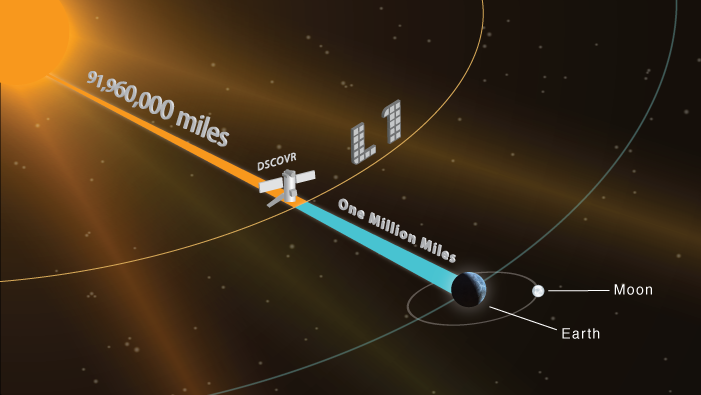
Image: L1 orbit diagram. Credit: NOAA.
SDO 5 years in space
It is not just DSCOVR that is getting everyone's attention. It was yesterday exactly 5 years ago that NASA's Solar Dynamics Observatory was launched into space. In honor of SDO's fifth anniversary, NASA has released a video showcasing highlights from the last five years of sun watching. Watch the movie to see giant clouds of solar material hurled out into space, the dance of giant loops hovering in the corona, and huge sunspots growing and shrinking on the sun's surface. Congratulations SDO!
Thank you for reading this article! Did you have any trouble with the technical terms used in this article? Our help section is the place to be where you can find in-depth articles, a FAQ and a list with common abbreviations. Still puzzled? Just post on our forum where we will help you the best we can!
Latest news
X1.9 solar flare, Coronal hole faces Earth
X4.0 solar flare
X5.1 solar flare, G4 geomagnetic storm watch
Latest forum messages
Support SpaceWeatherLive.com!
A lot of people come to SpaceWeatherLive to follow the Solar activity or if there is a chance to see the aurora, but with more traffic comes higher costs to keep the servers online. If you like SpaceWeatherLive and want to support the project you can choose a subscription for an ad-free site or consider a donation. With your help we can keep SpaceWeatherLive online!



Space weather facts
| Last X-flare | 2025/12/01 | X1.9 |
| Last M-flare | 2025/12/04 | M6.0 |
| Last geomagnetic storm | 2025/12/04 | Kp5 (G1) |
| Spotless days | |
|---|---|
| Last spotless day | 2022/06/08 |
| Monthly mean Sunspot Number | |
|---|---|
| November 2025 | 91.8 -22.8 |
| December 2025 | 186 +94.2 |
| Last 30 days | 106.3 +12.6 |