Viewing archive of Sunday, 5 July 2026
Daily bulletin on solar and geomagnetic activity from the SIDC
Issued: 2026 Jul 05 1231 UTC
SIDC Forecast
Solar flares
M-class flares expected (probability >=50%)
Geomagnetism
Moderate (ISES: Major) magstorm expected (A>=50 or K=6)
Solar protons
Warning condition (activity levels expected to increase, but no numeric forecast given)
| 10cm flux | Ap | |
|---|---|---|
| 05 Jul 2026 | 155 | 026 |
| 06 Jul 2026 | 155 | 024 |
| 07 Jul 2026 | 155 | 007 |
Solar Active Regions and flaring
Solar flaring activity was high over the past 24 hours, with one X-class flare and multiple M-class flares identified. The largest flare was an X1.3 flare (SIDC Flare 8130) peaking on July 04 at 20:41 UTC, produced by SIDC Sunspot Group 860 (NOAA Active Region 4479). A total of 7 numbered sunspot groups were identified on the visible solar disk over the past 24 hours. SIDC Sunspot Groups 907, 908, 909, and 910 newly emerged on the disk, while SIDC Sunspot Group 901 (NOAA Active Region 4480) rotated over the west limb. The two most complex and active regions were SIDC Sunspot Group 886 (NOAA Active Region 4478), currently located at S05W65 with a beta-gamma magnetic configuration, and SIDC Sunspot Group 860 (NOAA Active Region 4479), currently located at N16W83 with a beta-gamma-delta magnetic configuration. Most of the M-class flares during the period were produced by SIDC Sunspot Group 860 (NOAA Active Region 4479). An M1.5 flare (SIDC Flare 8135), peaking on July 04 at 19:36 UTC, was produced by SIDC Sunspot Group 886 (NOAA Active Region 4478). Solar flaring activity is expected to remain high over the next 24 hours, with M-class flares very likely and a chance for X-class flares, mainly from SIDC Sunspot Groups 860 and 886. Flaring above C-class from the newly emerged SIDC Sunspot Group 910 (NOAA Active Region 4482) is less likely but remains possible.
Coronal mass ejections
A Coronal Mass Ejection (CME) associated with the X1.3 flare (SIDC Flare 8130) became visible in GOES/CCOR-1 from around 22:30 UTC on July 04. This occurred during SOHO/LASCO and STEREO data gaps. Further coronagraph imagery and analysis are needed to determine the CME characteristics and possible impact. Several CMEs were observed over the past 24 hours. At the time of analysis, no clear Earth-directed component has been identified.
Coronal holes
SIDC Coronal Hole 170, an equatorial coronal hole with negative magnetic polarity, newly emerged on the eastern side of the visible solar disk over the past days. It is expected to reach the central meridian around July 06.
Solar wind
Solar wind conditions near Earth were disturbed over the past 24 hours, due to the passage of the interplanetary structure associated with the June 30 CME. The solar wind speed was elevated, varying mostly between about 550 km/s and 640 km/s. The total interplanetary magnetic field (Bt) was enhanced, reaching values up to about 24 nT around 00:33 UTC on July 04, before gradually decreasing later in the period. The Bz component reached a minimum value of about -19 nT around 01:05 UTC on July 04 and then gradually rotated northward, becoming weakly positive from around 09:30 UTC. The interplanetary magnetic field phi angle was mostly in the negative sector during the period then turn positive close to the end of the period. Enhanced solar wind conditions may persist over the next 24 hours, with further disturbances possible from late July 04 to July 05 due to the expected arrival of the interplanetary structures associated with SIDC CME 680, SIDC CME 681, and SIDC CME 682.
Geomagnetism
Geomagnetic conditions were disturbed to storm levels over the past 24 hours due to the enhanced solar wind conditions. Moderate storm conditions were observed globally, with NOAA Kp reaching 6 during the first part of the period. Locally, moderate storm conditions were also observed in Belgium, with K BEL reaching 6. Geomagnetic activity gradually decreased afterwards, reaching mostly quiet to unsettled levels by the morning of July 05. Geomagnetic activity is expected to be mostly unsettled to active over the next 24 hours, with minor storm intervals possible due to the possible arrival of interplanetary structures associated with the July 01 to July 02 CME activity. Isolated moderate storm intervals cannot be excluded if Bz turns southward again.
Proton flux levels
The greater than 10 MeV proton flux was slightly enhanced over the past 24 hours but remained below the 10 pfu threshold. A slight chance for a proton event remains over the next 24 hours due to the intense flaring activity, including from regions close to the western limb, in particular SIDC Sunspot Groups 860 and 886.
Electron fluxes at geostationary orbit
The greater than 2 MeV electron flux remained at normal levels over the past 24 hours. The 24-hour electron fluence remained below the alert threshold. The greater than 2 MeV electron flux is expected to remain at normal levels over the next 24 hours.
Today's estimated international sunspot number (ISN): 096, based on 14 stations.Solar indices for 04 Jul 2026
| Wolf number Catania | /// |
| 10cm solar flux | 161 |
| AK Chambon La Forêt | 074 |
| AK Wingst | 062 |
| Estimated Ap | 071 |
| Estimated international sunspot number | 098 - Based on 23 stations |
Noticeable events summary
| Day | Begin | Max | End | Loc | Strength | OP | 10cm | Catania/NOAA | Radio burst types |
|---|---|---|---|---|---|---|---|---|---|
| 04 | 1341 | 1351 | 1358 | N14W83 | M3.2 | 1 | 62/4479 | VI/2 | |
| 04 | 1602 | 1606 | 1611 | N14W82 | M1.1 | S | 62/4479 | ||
| 04 | 1836 | 1848 | 1903 | N13W81 | M1.9 | 1N | 62/4479 | ||
| 04 | 1923 | 1936 | 1940 | ---- | M1.5 | 63/4478 | |||
| 04 | 2029 | 2041 | 2047 | ---- | X1.3 | --/4482 | II/2VI/2 | ||
| 04 | 2216 | 2224 | 2229 | N13W81 | M1.1 | 1F | 62/4479 | ||
| 04 | 2346 | 2348 | 2353 | ---- | M1.0 | 62/4479 | |||
| 05 | 0024 | 0031 | 0036 | N16W83 | M1.3 | SF | 62/4479 | ||
| 05 | 0419 | 0432 | 0439 | N18W78 | M1.3 | SF | 61/4480 | ||
| 05 | 0441 | 0447 | 0452 | ---- | M1.0 | 62/4479 | |||
| 05 | 0521 | 0539 | 0549 | N18W80 | M2.7 | S | 62/4479 | ||
| 05 | 1056 | 1100 | 1102 | ---- | M1.4 | 62/4479 |
Provided by the Solar Influences Data analysis Center© - SIDC - Processed by SpaceWeatherLive
All times in UTC
Latest news
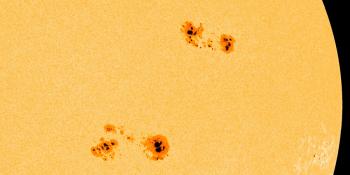
X1.1 solar flare, G2 watch
G3 geomagnetic storm watch for 4 and 5 June
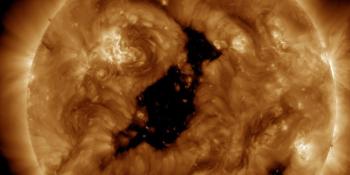
Coronal hole faces Earth
Latest forum messages
Support SpaceWeatherLive.com!
A lot of people come to SpaceWeatherLive to follow the Solar activity or if there is a chance to see the aurora, but with more traffic comes higher costs to keep the servers online. If you like SpaceWeatherLive and want to support the project you can choose a subscription for an ad-free site or consider a donation. With your help we can keep SpaceWeatherLive online!



Space weather facts
| Last X-flare | 2026/07/04 | X1.3 |
| Last M-flare | 2026/07/08 | M1.5 |
| Last geomagnetic storm | 2026/07/04 | Kp7+ (G3) |
| Spotless days | |
|---|---|
| Last 365 days | 3 days |
| 2026 | 3 days (2%) |
| Last spotless day | 2026/02/24 |
| Monthly mean Sunspot Number | |
|---|---|
| June 2026 | 94.4 -7.1 |
| July 2026 | 101 +6.6 |
| Last 30 days | 94.4 -10.7 |