Viewing archive of Friday, 31 January 2014
Daily bulletin on solar and geomagnetic activity from the SIDC
Issued: 2014 Jan 31 1221 UTC
SIDC Forecast
Solar flares
Active (M-class flares expected, probability >=50%)
Geomagnetism
Quiet (A<20 and K<4)
Solar protons
Quiet
| 10cm flux | Ap | |
|---|---|---|
| 31 Jan 2014 | 163 | 002 |
| 01 Feb 2014 | 165 | 006 |
| 02 Feb 2014 | 166 | 024 |
Bulletin
Solar activity has been at active levels over the last 24 hours. 6 C- and 1 M-class flares were recorded, all originating from NOAA 1967. The strongest was an M6-flare peaking at 16:11UT. The sunspot region still has a few magnetic delta structures. The x-ray background has been all day above the C1-level. Active conditions are expected to continue, with a slight chance on an X-class flare. A partial halo CME was observed in LASCO/C2 starting at 08:12UT. It was most probably associated to the M2-class event that took place in NOAA 1967 (maximum at 06:39UT). It has a slow speed of about 350 km/s. A full halo CME was observed in LASCO/C2 starting 16:12UT. It was associated to the M6-flare, and had an initial plane-of-sky speed of 1735 km/s (latest CACTUS result). The bulk of the CME was directed away (to the southeast) from Earth. It is very likely this CME will overtake the partial halo CME of the M2-event. Solar wind parameters are currently at average levels, with a speed near 350 km/s and Bz fluctuating between -3 and +3 nT. Geomagnetic conditions were quiet. For the next 24 hours, solar wind may continue to be modulated by the effects of small coronal holes that have passed the central meridian on 27 and 29 January. Quiet geomagnetic conditions are expected for that period. Late on 1 February, Earth may receive a glancing blow from the 29 January CME, but little geomagnetic disturbances are expected. This may change upon the arrival of the CME from the M6-event, which is currently foreseen for the morning of 2 February. This may result in active geomagnetic conditions, with locally a minor storm possible.
Today's estimated international sunspot number (ISN): 065, based on 14 stations.Solar indices for 30 Jan 2014
| Wolf number Catania | /// |
| 10cm solar flux | 161 |
| AK Chambon La Forêt | 004 |
| AK Wingst | 002 |
| Estimated Ap | 003 |
| Estimated international sunspot number | 074 - Based on 11 stations |
Noticeable events summary
| Day | Begin | Max | End | Loc | Strength | OP | 10cm | Catania/NOAA | Radio burst types |
|---|---|---|---|---|---|---|---|---|---|
| 30 | 1548 | 1611 | 1628 | S13E58 | M6.6 | 2N | 220 | 28/1967 | VI/1 |
Provided by the Solar Influences Data analysis Center© - SIDC - Processed by SpaceWeatherLive
All times in UTC
Latest news

X1.5 solar flare

M2.7 solar flare, CME arrival possible
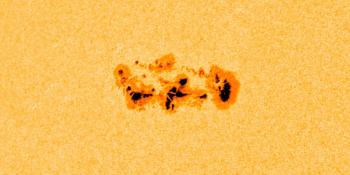
Complex sunspot region 4366
Latest forum messages
Support SpaceWeatherLive.com!
A lot of people come to SpaceWeatherLive to follow the Solar activity or if there is a chance to see the aurora, but with more traffic comes higher costs to keep the servers online. If you like SpaceWeatherLive and want to support the project you can choose a subscription for an ad-free site or consider a donation. With your help we can keep SpaceWeatherLive online!



Space weather facts
| Last X-flare | 2026/03/30 | X1.5 |
| Last M-flare | 2026/04/04 | M1.3 |
| Last geomagnetic storm | 2026/04/03 | Kp7- (G3) |
| Spotless days | |
|---|---|
| Last 365 days | 3 days |
| 2026 | 3 days (3%) |
| Last spotless day | 2026/02/24 |
| Monthly mean Sunspot Number | |
|---|---|
| March 2026 | 85.9 +7.7 |
| April 2026 | 133.3 +47.4 |
| Last 30 days | 96.1 +32 |